How to make tempeh


Making tempeh is very easy. Here we explain how to make tempeh from 100% soy. This is the traditional tempeh as it is consumed in the country of origin: Indonesia. But soy tempeh is also the most popular tempeh in other countries. To make 1kg tempeh you need the following ingredients:
- 600 g whole dry soybeans
- 5 tablespoons vinegar
- 1 teaspoon (about 3 to 5 grams) tempeh starter
Step 1: Cracking the soybeans
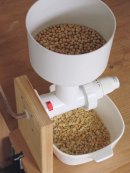 The easiest way is to crack the soybeans with a loosely set grain mill. Ideally each soybean is cracked in half. On the left you can see a picture of a Family Grain Mill. This grain mill can be bought on the internet for less than $150. With the Family Grain Mill you can split the 600 g soybeans in a few minutes. Daniel informed us that the Porkert Universal Grain Mill can also split the soybeans. It is a Czech made grain mill that is all hot dipped steel, easy to take apart and lasts a long time. Another grain mill that seems to do the job is the Country Living Grain Mill.
When buying a grain mill consider that you can also use the dehulled soybeans to make soymilk. If you don't have a grain mill or dehulled soybeans continue with using whole soybeans, you will have to remove the hulls later by hand. If you are lucky, you can find a store that sells dehulled soybeans. Industrial tempeh producers normally buy dehulled soybeans. Maybe they will sell you some soybeans!
Step 2: Soaking and dehulling soybeans
Soak the soybeans in 2 liter water for 6 - 18 hours. If you use whole soybeans you should split them by squeezing them with a kneading motion. Stir gently causing the hulls to rise to the surface, then pour off water and hulls into a strainer. Add fresh water and repeat until most hulls are removed. Don't worry if a few hulls remain attached.Step 3: Cooking the soybeans
Put the beans in a cooking pot and add enough water to cover them. Add the vinegar and cook for 30 min. Drain off the water and dry the soybeans by continue heating them in the pot on medium heat for a few minutes and until the beans are dry. Allow the soybeans to cool down to below 35°C.Step 4: Inoculating the soybeans with tempeh starter
Sprinkle the soybeans with 1 teaspoon of tempeh starter. Mix with a clean spoon for about 1 minute to distribute the tempeh starter evenly. It's very important to mix the tempeh starter very well: it reduces the risk for spoilage and the fermentation will be faster. To promote the home production of tempeh we will send you a sample of tempeh starter.Step 5: Incubating the beans
Take 2 plastic bags 18 x 28 cm and perforate them with holes at a distance of about 1 cm by a thick but sharp needle. A normal needle is too thin, you need a fat needle or small nail (about 0.6 mm in diameter). This will allow the mould to breathe. Divide the soybeans in the two bags and seal them. Press them flat, making sure that the total thickness of the beans is max 3 cm. Place the packed beans in an incubator at 30°C or at a warm place for about 36- 48 hours during which the tempeh fermentation takes place. Then the container should be filled completely with white mycelium and the entire contents can be lifted out as a whole piece.Making other types of tempeh
The most popular tempeh is soybean tempeh. But you can also make tempeh with other substrates:Now you know how to make tempeh. We hope that you will enjoy the home making of tempeh and ... the eating of it! If you have questions about how to make tempeh, please Email us! If you like to make tempeh at home, maybe you should consider to also make your own natto with this excellent natto starter. Natto is fermented by a Bacillus subtilus, which is a powerful probiotic.


What is your reason for choosing this article ?
BalasHapusBecause tempe is very easy to make, in addition to tempe also occurs chemical reactions, and tempeh nearly 90 percent of people in Indonesia love it
HapusOn the manufacture of tempeh, can fail if?
BalasHapusSome of the things that caused the failure include:
Hapus1. Hygiene and soybean drying. In the process of washing, and stripping of soybeans, hygiene is an important factor to note. After the process of leaching and stripping of the epidermis, soybeans should be dried before the yeast is given. If the soy is not dry enough, the fermentation process will fail and the soybeans quickly decompose.
2. Room temperature. Temperature is very influential on fermentation process and the development of fungus Rizopus after fermentation process on soybean, which is about 25'-32 'celcius. If the room temperature is too low will inhibit the growth of fungi whereas if the temperature is too hot will cause overheating of the candidate tempe, so the soybean will be easy to rot.
3. Humidity. In addition to temperature, the humidity of the air where the storage of tempe determines the success of tempe. The mushrooms will be easy to grow with enough moisture levels.
We know that tempe usually uses yeast, what is the yeast molecular formula?
BalasHapusFermentation is the process of energy production in cells in anaerobic state (without oxygen). In general, fermentation is one form of anaerobic respiration, however, there is a clearer definition that defines fermentation as respiration in an anaerobic environment with no external electron acceptor.
HapusThe reaction in fermentation varies depending on the type of sugar used and the resulting product. Briefly, glucose (C6H12O6) which is the simplest sugar, through fermentation will produce ethanol (2C2H5OH). This fermentation reaction is carried out by yeast, and is used in food production.
Chemical Reaction Equation:
C6H12O6 → 2C2H5OH + 2CO2 + 2 ATP (Energy released: 118 kJ per mole)
Described as:
Sugar (glucose, fructose, or sucrose) → Alcohol (ethanol) + Carbon dioxide + Energy (ATP).
Tempe is a food made from fermentation to soybean seeds or some other ingredients that use several types of Rhizopus molds, such as Rhizopus oligosporus, Rh. Oryzae, Rh. Stolonifer, or Rh. Arrhizus, thus forming a compact white solid. This fermentation preparation is commonly known as "yeast tempeh".
White color in tempe is caused by mycelia fungus that grows on the surface of soybean seeds. Compact texture is also caused by the mushroom mise1ia connecting the soybean seeds. Lots of fungi are active during fermentation, but most researchers assume that Rhizopus sp is the most dominant fungus. Mushrooms grown in soybeans produce enzymes that are able to remodel complex organic compounds into simpler compounds so that these compounds can quickly be used by the body.